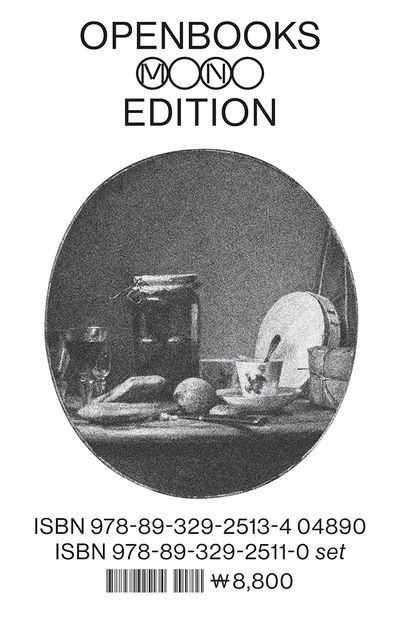
After finishing Zorba the Greek, I started browsing the Mono Editions published by Open Books, wondering what I should read next.
Most of them were famous books I’d heard of at least once, such as The Metamorphosis, The Old Man and the Sea, and 1984.
Then I came across this book in the search results. I clicked on it, wondering what kind of book it was. I had absolutely no intention of reading it.
At the time, I was trying to decide whether to read The Brothers Karamazov or The Adventures of Huckleberry Finn first.
I skipped the book description and went straight to the reviews. One of the reviews by a member of the book review panel caught my attention. So the very next day, I went to a bookstore and bought the book.
When I was in college, I once took a creative writing class as an elective, and the professor said something like this: "The life of a person who writes does not easily fall apart." Of course, he added that this didn't mean such a person would never become poor. I thought that might be true, but at the same time, I wondered, "Is that really the case?" Most of what we write about consists of thoughts we normally carry with us or very ordinary, everyday things that happen around us.

... omitted

What if he had continued recording his life throughout his years, rather than doing so only when he was on the verge of death? Perhaps he would have realized sooner that the illnesses, wandering, love, and achievements he experienced were the extraordinary parts of an ordinary life, and the things that make life richer.

As I read this book, I finally understood what my professor had meant. A life that does not easily fall apart is one in which you learn to look at the things you once dismissed as ordinary from a new perspective. Keeping a record helps you organize your life, look back on it, and move in a better direction. Perhaps the reason a writer's life does not easily fall apart is that, by reflecting on their own life, they are steadily becoming stronger, like an animal growing strong by being fed grass.
Since starting my blog and recording my thoughts about the things I see, hear, and feel in everyday life, I’ve come to realize how enjoyable it is to leave behind traces of my own life.
To simply pass by flowers and trees without giving them much thought, to treat a road or a place as nothing more than a destination you can reach by opening Naver Maps, or to look at other people’s words and appearances only in fragments and quickly judge them.
I’ve also come to realize that these are dull ways of living that make life monotonous and passive.
Perhaps I might have gone through life without recognizing the value of the things around me, only to grow older and regretfully wonder, “Why did it take me so long to realize these things?”
That made me curious about how someone on the verge of death, in contrast to me, would have written about their own life. That was why I wanted to read this book.
Like Shūji Tsushima’s No Longer Human, the book uses a frame narrative in which the beginning and end of the story surround the main body of the narrative. The story begins when Popel, who knew the protagonist to some extent, receives his memoirs from the doctor who had examined him.
And just like the protagonist who accompanied Zorba to Crete in Zorba the Greek, the protagonist is never given a name.
The protagonist knew he was going to die soon because the heart disease he had been suffering from had grown worse.
So, in preparation for death, he began putting his affairs in order. He checked and organized all his documents and letters.
He had put everything in order, neat and tidy, yet somehow he still felt anxious and empty. He realized that he had never organized his life itself, so he decided to briefly record the life he had lived.
As if someone were watching him and making fun of him, the protagonist showed a slight sense of embarrassment. But he soon became serious, saying that he was going to write the biography of a completely ordinary person, and began looking back on his life.
He said there was nothing to be ashamed of in having lived an ordinary life without any extraordinary experiences, and that, overall, he had been happy.
The biography first tells the story of his life. Then the selves that had been hidden within him, knowingly or unknowingly, begin to emerge, creating an inner conflict, and toward the end, they come together to bring the story to a close.
The first part follows the passage of time, covering his childhood, adolescence, university years, his time as a railway clerk, married life, and eventually his years as a stationmaster.
Every stage of life is probably important enough that it is difficult to simply cast it aside, but among them, I think childhood had the greatest influence on the protagonist.
Born as the son of a butcher, the protagonist had an older brother who had already died before he was born. And because he was naturally frail, his mother took exceptionally good care of him.
His mother was emotional and romantic, while his father was a strong and authoritative man who worked hard, was honest, and was respected in the village. He valued diligence and stability above all else, and hoped that his son would do well in school and eventually succeed in life.
Because his mother cared for him so much and was constantly worried about him, the protagonist grew up quiet and introverted, causing him to be isolated or ignored by his friends.
Instead, he let the children ride the seesaw he had at home so he could play with them, or stood beside his father on the platform during church festivals, briefly enjoying the sense of superiority that came from being above the other children.
But that was all. On most days, when he wasn’t riding the seesaw with the other children or there wasn’t a village event, the protagonist was alone.
Feeling hurt and resentful, the protagonist resolved to at least excel at school.
He says that as he went through school, he realized that the world he lived in consisted of two separate worlds.
One was the ordinary world inhabited by his father, the butcher, and other people who worked hard. The other was a higher world inhabited by people of a higher social class, such as doctors, administrators, and priests.
The protagonist realized at a young age that society had a hierarchy.
The loneliness he felt from being excluded by his friends, the sense of superiority he experienced thanks to his father, and his encounters with people who held power led the protagonist to develop a gloomy self and an aggressive self that craved recognition.
In another experience, he built a small world of his own in a corner near the butcher shop, putting up a fence with branches. He felt a pastoral kind of happiness there, and from then on became interested in creating a world of his own, cut off from the outside.
Meanwhile, construction was underway in the village to lay a railway. Seeing it, the protagonist vaguely dreamed of working with trains or at a construction site.
The quiet protagonist went on to attend an upper-level school in the city and achieved excellent grades. During his school years, his father was extremely proud of him.
But studying was not about achieving any particular goal. As a country boy, the protagonist simply didn’t want to fall behind his city friends, and since he couldn’t fit in with them, he wanted at least to beat them academically.
He says that his eight years at school were the years of his youth he spent preparing to pass through life almost empty-handed and eventually gain true freedom.
After completing his graduation exams, he entered the philosophy department of a university in Prague.
When he arrived at Prague Station by train, he felt bewildered because he didn’t know where to go or what to do. He says he felt as though everyone was looking at him and laughing at him.
While walking through the streets carrying his luggage, he ended up entering a boarding house, where he came to live with a drunken poet.
As he lived with him, he gradually became influenced by him. The exemplary person he had been throughout his school years disappeared, and he began drinking, viewing everything pessimistically, writing poetry, and wandering aimlessly.
In order to erase the memory of being laughed at in Prague Station, this time he mocked the world himself.
Eventually, he dropped out of university. When his father heard the news, he came to Prague himself and caused quite a scene.
Wanting to become financially independent from his family, the protagonist applied for a low-level civil service position with the railway administration. Fortunately, he was appointed as a trainee and began working as a railway clerk at a station in Prague.
As a child, he had dreamed of working with railways, and now the person who had felt humiliated upon arriving somewhere by train had become a railway clerk.
Having unexpectedly fulfilled a childhood dream, he began living a life closely connected to the railway from that point on.
Then he began coughing up blood and was transferred to a station in the mountains. While working there, he continued a simple, pastoral, and lyrical life.
After recovering his health, he was transferred to another station, where he immersed himself in the world created by the stationmaster and devoted himself to his work.
He then married the stationmaster’s daughter and managed to balance his working life and married life. In his own words, he spent the happiest period of his life.
With the help of his father-in-law, he became the stationmaster of another station at a relatively young age.
The small world he had once built with a fence near his childhood home had now become a railway station. For the protagonist, the station was both a childhood game and a place where he could devote himself wholeheartedly to something.
So absorbed in his affection for his little world, he put his relationship with his wife aside and focused more on running the station.
He welcomed aristocrats who lived even higher up the social ladder than the people of the “higher world” he had seen in the countryside, briefly getting a taste of power.
But that small world did not last long. When war broke out, the station he had worked so hard to build was turned into a place for transporting supplies and troops, leaving it damaged and ruined.
The protagonist lost his affection for his station and, after the war ended, continued his life by joining the new railway administration of the newly established republic.
That is where the book finishes describing the course of his life. From the middle of the book onward, however, selves other than his “ordinary” self begin to appear, and the conflict begins.
The first to appear is an aggressive self who is willing to do anything to get ahead. He begins a conversation with the ordinary self.
This self has a tenacious personality and is referred to as “the tenacious one.” He reveals in no uncertain terms the hidden desires contained within everything the ordinary self had described up to that point.
At first, the protagonist denies them, but gradually begins to acknowledge them. Then another self appears—the gloomy self who seeks only a passive and secure life.
The ordinary self, the aggressive self, and the gloomy self. These three selves are said to have been the major selves that occupied most of his life.
There are also many other selves: a poet, a romantic, a beggar who pursues a pious life of simple contentment, a war hero, and others.
Each self was created through experiences the protagonist had in the circumstances he found himself in.
When a particular self emerged as the dominant one, it appeared as a particular way of living or a particular desire in the protagonist’s life.
Not every self became a dominant one, but each had clearly appeared as a part of him at certain moments and for certain periods of time.
Through this, he begins to understand life by imagining how a particular self could come to dominate him.
This allows him to see his own life reflected in these possibilities. Rather than seeing life as something that simply unfolded over time, he says he can imagine all the infinitely many lives that “were” and “could have been” at once.
In other words, he realizes that the life he lived was only one among countless possible destinies, rather than the inevitable result of his circumstances.
The periods when he went to school, attended university, lived as a poet, served as a stationmaster, and worked as a civil servant for the railway administration were only fragments of the countless lives he could have lived. Realizing this, the protagonist begins to see the ordinary course of his life—which he thought he knew so well—as something magnificent and mysterious.
He also comes to understand how these selves were formed by looking at the other people who remained in his memories.
Through internal conversations with the people around him, the protagonist learns that the romantic was shaped by his mother, the pious beggar by his grandmother, and the war hero by his grandfather.
He also talks with his brothers who could have existed but never did—other versions of himself, such as an adventurer, a butcher, or a womanizer—and they talk about the lives he might have lived had things gone differently.
Going even further, he realizes that other people’s personalities are also simply one manifestation among countless possibilities, just as his own is, and that he himself could have become one of those people.
Those possibilities exist within the protagonist as well, and some aspects of other people may have lived a part of his own life.
The wise and quiet old signalman, the drunken captain—each of them could have been a life the protagonist might have lived.
Therefore, he realizes that if he looks closely at these people, he will see a part of himself in each of them.
The more people he understands and accepts, the more of himself he discovers, and his life becomes more complete. The inner selves that had existed only as possibilities begin to appear in reality through other people.
A life of understanding others. That, the protagonist says, was his ordinary life. Finally, he ends his biography by boarding an imaginary train filled with all the people from his memories who had shared his life.
After reading the entire autobiography, Popel returns the book to the doctor who had cared for the protagonist and says that his own life had not been ordinary like the protagonist’s.
The young doctor says that he has no interest in searching through his own inner self. Instead, he says that he went to the garden the protagonist had tended and worked on the trees, making sure that everything remained in order even after the man’s death. And with that, the story of the novel comes to an end.
Looking back at the review that made me buy the book, I realized that it had focused more on the life of keeping records than on the message the book itself was trying to convey. Of course, that was also what I had expected when I bought the book.
But the book turned out to be much deeper and more profound than I had expected. Whenever I came across a part I didn’t understand, I read it over several times.
Despite its title, the book was anything but ordinary.
Perhaps I could have easily encountered the idea of keeping a record of one’s life elsewhere. Maybe I already knew to some extent what it meant to keep records, so the subject might even have felt tedious.
Instead, rather than focusing on the act of recording, I learned a new way of looking at life and other people.
A person is only one manifestation among countless possibilities, and we can discover other possibilities of ourselves through other people. Some of those possibilities may also exist within us. That was the more valuable lesson for me.
The protagonist says, “Life is a collection of many different possible lives. Only one or a few of them are realized, while the others either appear only in fragments or occasionally, or never appear at all. I think that’s how everyone’s story is.”
Because this man looked back on himself from childhood to the present as he approached the end of his life, he was able to see the whole collection of lives he had lived.
I can’t do that yet. They say there is no set order to the path we take through life, but if I assume that I live until I’m just short of seventy, like the protagonist, then as I write this, there are still more days ahead of me than the days I’ve lived so far.
Even so, when I look back at the versions of myself that I’ve experienced or revealed so far, I realize that I too have only revealed some of the many possibilities that could have been.
Looking back now, I sometimes think, “Ah, I could have taken that path too,” as I retrace my memories. I didn’t know it at the time, but that was an opportunity to live as a different version of myself.
While going to school, working with a communications NCO in the military, working part-time at a restaurant, helping my great-uncle with his work, working at Starbucks and my previous job, and spending time with friends and romantic partners, I got to see various sides of myself.
This was something I had naturally done even before reading this book. After all, thinking about the past is something anyone does.
But the book’s lesson—that some of those different selves may also exist within me—expanded the way I had previously thought about other people, which was mostly to learn from their mistakes or try to emulate what they did well.
At the same time, it made me wonder why certain sides of me exist but have never appeared.
And it left me wondering what paths I will take and what versions of myself will emerge if I, like the protagonist, live a life long enough to accumulate many different experiences.
Perhaps one day I will write my own biography. Maybe only then will I come to understand what an ordinary life means to me.