At the beginning of the month, I visited the Seoul Museum of Art’s Nam-Seoul Museum of Art near Sadang Station.
The building was originally used as the Belgian Consulate in Hoehyeon-dong before being relocated to its current location in Gwanak-gu in the 1980s, when it became one of the Seoul Museum of Art’s exhibition spaces.
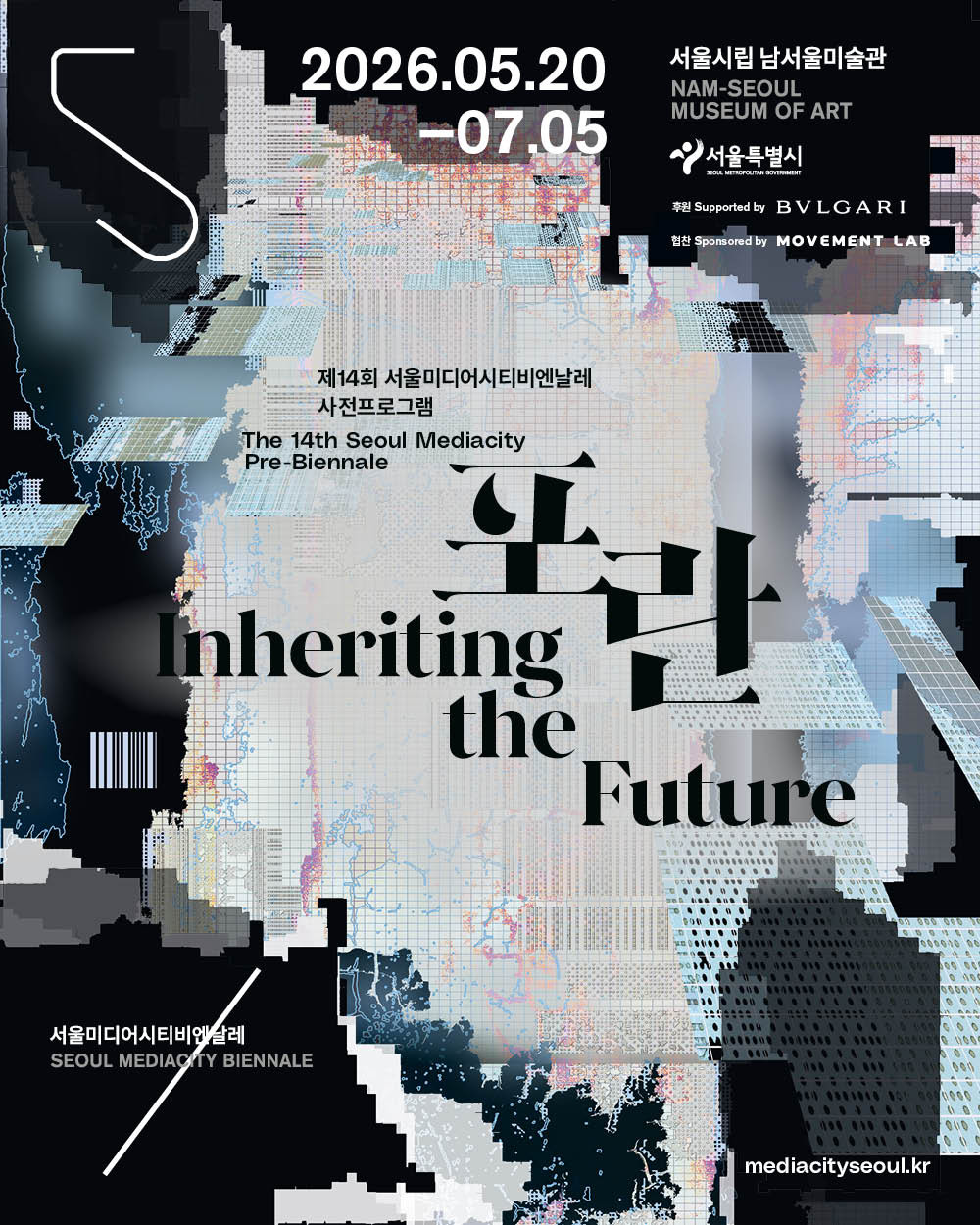
On the first floor was a permanent exhibition of works by Kwon Jin-kyu, while the second floor was hosting Poran, a pre-Biennale program for the Seoul Mediacity Biennale.
A biennale is a large-scale international art exhibition held every two years. The Venice Biennale in Italy was the first of its kind, and the concept has since spread to cities around the world.
Rather than following a fixed format, biennales function as platforms for introducing art through the unique characteristics of each country or city, while also raising various questions and conveying messages through art.
In Korea, there are biennales in Seoul, Busan, and Gwangju. They were originally all held in even-numbered years, but Seoul and Gwangju each postponed their events by a year during the COVID-19 pandemic. As a result, Busan now holds its biennale in even-numbered years, while Seoul and Gwangju hold theirs in odd-numbered years.
That’s why, ahead of next year’s biennale, Poran was being held as a pre-Biennale program to look back on the activities of previous biennales and prepare for the upcoming one.
The Seoul Mediacity Biennale is said to be the only biennale in Korea organized by an art museum, the Seoul Museum of Art. (The Busan and Gwangju biennales are operated by local governments and separate corporations or organizing committees.) It has served as a space for sharing ideas and experiences related to Seoul and media.
The title of the program, Poran, refers to the act of incubating an egg.
According to the leaflet, the “egg” represents an uncertain new possibility whose outcome cannot be predicted.
The uncertainty of the egg becomes a question about the future, while the act of incubating it, poran, serves as a metaphor for a biennale that holds and carries those questions.
What I wanted to remember from this exhibition were the questions introduced in the leaflet. They condensed what the Seoul Mediacity Biennale has explored over the years into a handful of concepts.
Rather than seeking clear answers, the questions showed what the central themes of the biennale’s exhibitions had been. At the same time, they made me curious about how artists had transformed questions surrounding the relationship between the city, media, and technology into works of art.
I also thought these questions could indirectly or directly help us reflect on our own everyday lives.
- How do technology and media reshape human senses and experiences?
- What are the conditions for relationships formed in a connected world?
- How does language construct the world while simultaneously revealing the impossibility of communication?
- How do invisible structures and forms of power operate, and how can resistance be organized within them?
- How are boundaries reconstructed, and in what ways can we rethink the world?
Walking
When you walk around the neighborhood, you can meet some interesting friends.
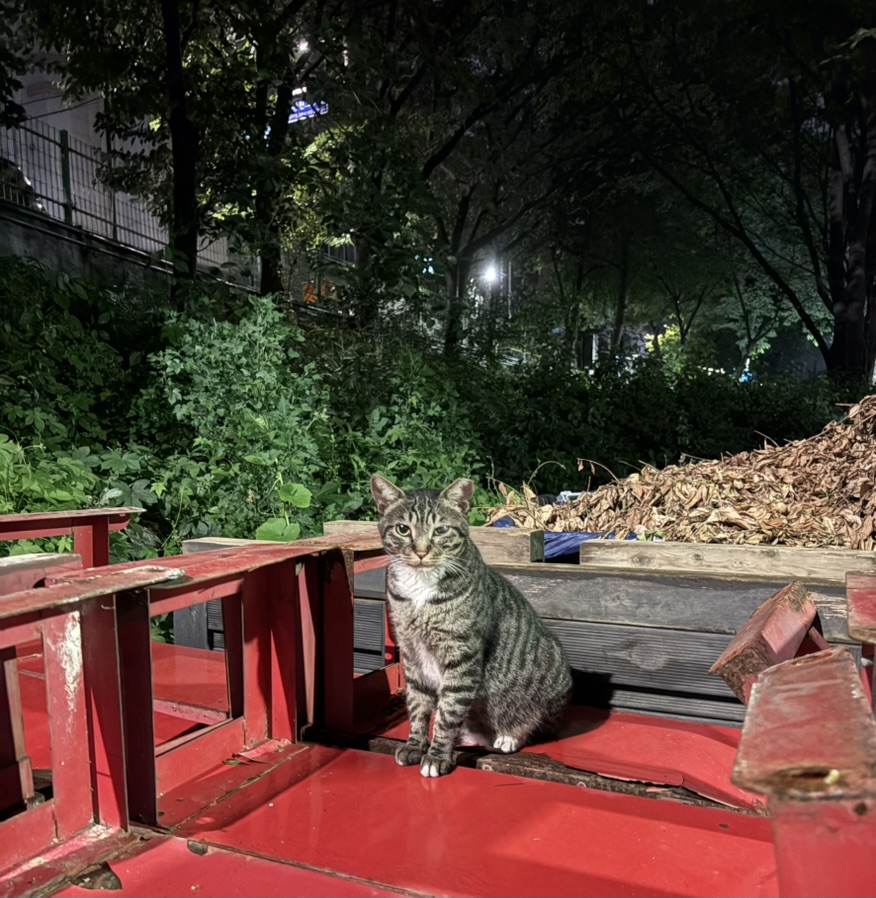
My favorite of them is Chun-jang. This little guy has a calm and affectionate personality, so he’s pretty popular with a lot of people.
It seems like a few people regularly feed him, but maybe he manages his own diet because he maintains a pretty healthy figure.
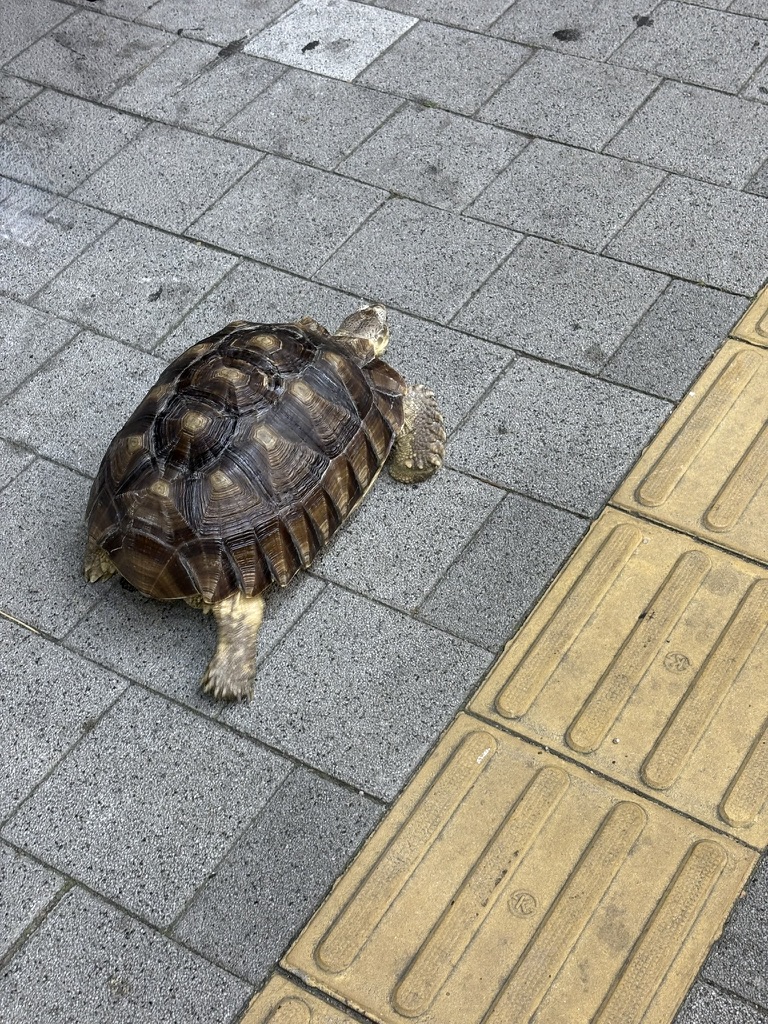
The second is a turtle. There’s an independent bookstore called Eunggeum Bookstore across from the entrance of Kakongjok’s Dangok Intersection location, and this is where the turtle lives.
It’s quite a big one. I picked it up once before, and I remember it being pretty heavy. I think Chun-jang might actually take an interest in this turtle for a little while if he ever saw it.
The owner sometimes puts it outside to let it get some fresh air, and it’s pretty cute watching it slowly crawl along.
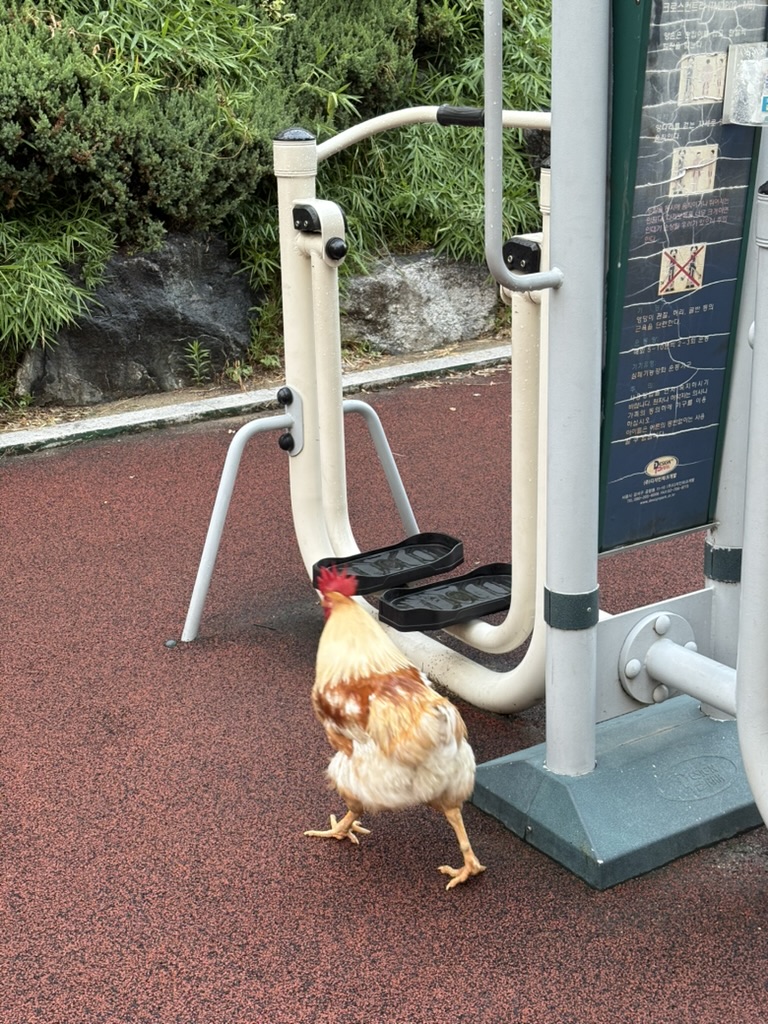
The last one is a chicken. If you go to Dorimcheon around the afternoon or evening, you can sometimes see a chicken that someone keeps there.
Like the turtle at Eunggeum Bookstore, this chicken is huge. Honestly, I’ve never seen a chicken this big before.
With its bright red comb, golden feathers, and straight, sturdy legs, it reminds me more of a dinosaur than a chicken.
Chun-jang is actually a little timid, so I feel like he’d get startled by this chicken and run away as fast as he could.
You can meet all kinds of interesting friends like these when you go for a walk. You can observe people, too, and simply take in the neighborhood around you.
Once summer is over and the weather cools down, I want to walk through representative neighborhoods in each district of Seoul. There are 25 autonomous districts in Seoul, so I think it could be fun to get to know them one by one.
Anime & Movies
I watched an anime called Chainsaw Man.
After being repeatedly disappointed by Demon Slayer, I’d mostly been watching Studio Ghibli films here and there. Chainsaw Man was the first series I’d really gotten absorbed in since Attack on Titan.
It’s technically a shōnen manga adaptation, but unlike the usual anime where the protagonist goes through all kinds of hardships and gradually becomes stronger, it breaks just about every cliché and moves the story along at a surprisingly fast pace.
This was the most memorable scene in the series: the first appearance of the Fox Devil. It looked so cool that I found myself copying the hand gesture for no reason and even called out “Kon.”
Unfortunately, after this scene, the Fox Devil mostly gets pushed around by other devils, which was pretty disappointing.

Next was Chainsaw Man – The Movie: Reze Arc. Like Denji, Reze is a weapon hybrid and an assassin sent from the Soviet Union to take Denji’s heart—the heart of Chainsaw Man.
The two first encounter each other in a phone booth, but instead of killing Denji right away, Reze starts to develop feelings for him.
Denji starts visiting the café where Reze works every day, and the two spend time together. The scene below is where Reze tells Denji that she’ll teach him how to swim and asks him to get into the pool.
Even though Reze is the Bomb Devil and therefore most vulnerable in the water, she shows Denji her true self without putting on an act.
Later, during a romantic fireworks festival, Reze confesses her feelings to Denji and suggests that they run away together. When Denji turns her down, the tragic part of the story begins.
Denji transforms into Chainsaw Man and, with the help of his comrades, manages to hold out until he finally survives the fight against Reze.
Near the end of the movie, Denji tells Reze that they should run away together and says he’ll wait for her at the café.
Reze initially seems to turn him down, but just as she’s about to leave on a train, she turns around and heads back to the café to meet Denji.
Just as she’s almost there, she runs into Makima in the alley she always passes through. She is attacked by the Angel Devil, and the two ultimately have to part ways.
Reze, like Denji, had never even been to school and had spent her life being used by others. The fact that their innocent, youthful love never got the chance to continue made the story linger with me even more.

I watched eight movies.
The French Chef, Sleepless in Seattle, Midnight in Paris, Chungking Express, Chef, Decision to Leave, Nobody’s Daughter Haewon, and Princess Mononoke.
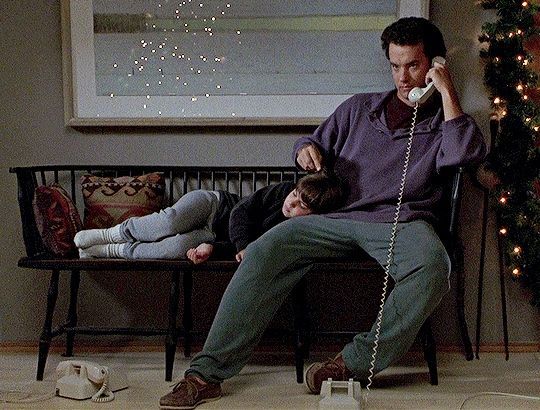
They’re all movies I could bring up if someone asked me to recommend a film, but if I had to pick just one, it would be Sleepless in Seattle.
It’s a romantic comedy, but unlike most romance movies, the two main characters probably spend less than ten minutes together over the entire runtime.
So how can it possibly be a romance? Watch it yourself and you’ll understand. Before you know it, you might find yourself rooting for the two of them to meet.
It’s also a great movie for enjoying Meg Ryan and Tom Hanks’ performances and styling, as well as that cozy 1990s atmosphere.
Deadbeat
Deadbeat is Tame Impala’s album released five years after The Slow Rush. I believe it was first announced sometime around July or October of last year.
I liked the final piano outro of the song “No Reply.” It evokes a sense of longing and wistfulness while still having a slightly raw quality to it.
So I cut out just the very end and uploaded it to the blog. No Reply
Apparently, “deadbeat” can refer to a dead beat—a lousy or amateurish beat—or to someone who refuses to work, lacks responsibility, and fails to fit into society. In other words, a slacker or someone who’s unemployed.
The first track, “My Old Ways,” seems to be about Kevin Parker himself, or perhaps a fictional character, falling into the same temptations over and over again, repeating the same mistakes, and eventually becoming resigned to them.
The Korean word hallyang describes someone who lives without a regular job, simply playing around and enjoying life. It felt like a pretty good description of my own life—trying this and that because I want to make something of myself, only to eventually end up right back where I started.
Sometimes, going to an exhibition, watching a movie, reading a book, or looking up things I’m curious about—all these cultural activities and acts of contemplation—can suddenly feel completely pointless and meaningless.
I start wondering if I’m really doing these things as an escape, while avoiding the things I should actually be doing right now.
Then I find myself endlessly wondering why I keep making the same mistakes, whether I can really change, and how I want to change. And yet, there are also moments when I’m filled with positive thoughts: Maybe things will work out this time. I’m doing a little better than before. I learned something new from this.
While looking through Reddit to see what other people thought about the album, I came across a comment that I found oddly comforting.
Which is quite relatable, bc sometimes you’re the dickhead and sometimes you’re getting shit on.

And somewhere inside this rat race of a deadbeat fest are a few moments where there is some real connection. And those moments wouldn’t have come if you hadn’t been what you were.

So what even is bad, if it brings you to something good. Like a new perspective on regret, those things you spend time regretting actually brought you where you are today and made you who you are.
If something ultimately leads to a good outcome, maybe the things that happened along the way weren’t necessarily bad. Maybe they were the very things that brought me to that outcome.
Is this what they mean by “every cloud has a silver lining”?
Whether the outcome is good or bad, I know that I’m someone who keeps moving forward, even while going around in circles and repeating the same patterns.
And I know these questions will keep coming back to me from time to time, because, like the questions raised by Poran, they aren’t meant to provide answers so much as messages that point me toward what comes next.
Tomorrow, I’m going to welcome the sun again.